
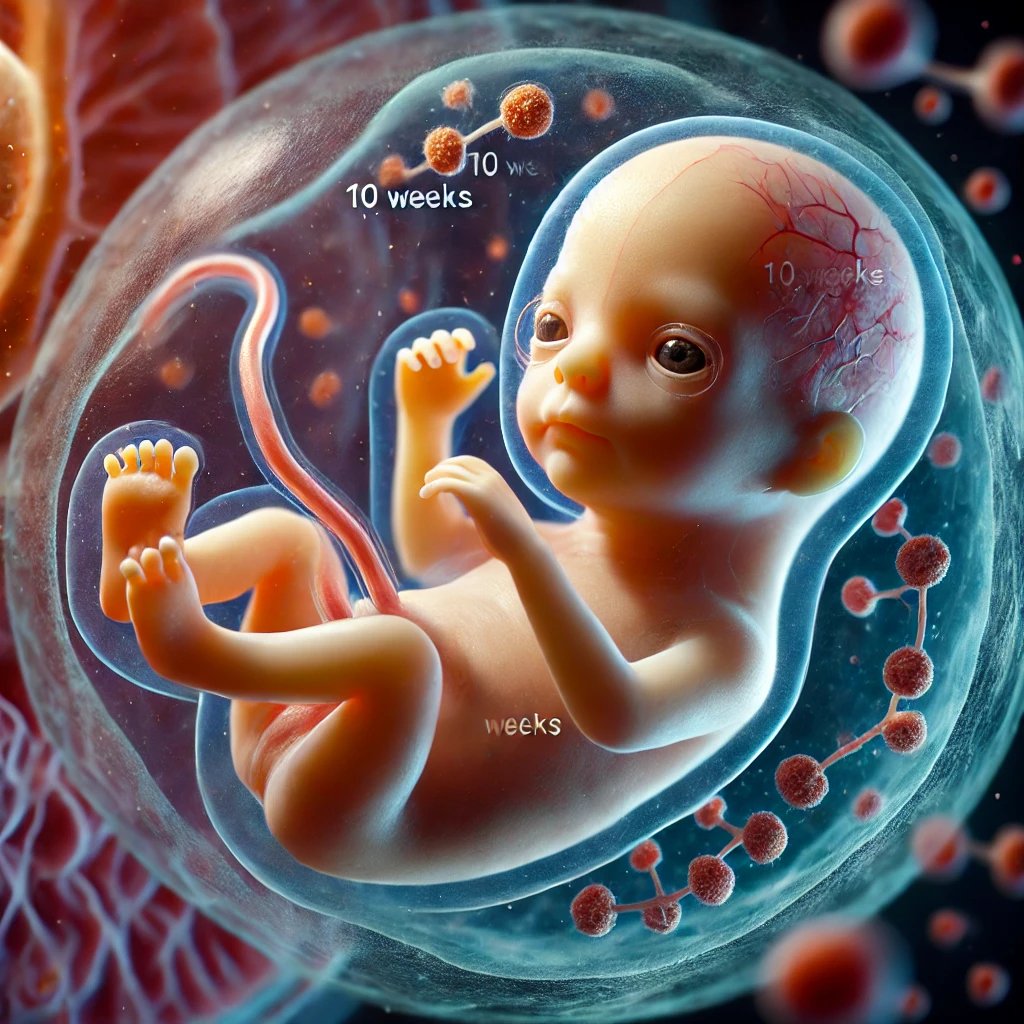
10 Weeks Pregnant: The Fingers Separate and the Embryo Becomes a Fetus
- Length 3.1 cm crown to rump
- Weight 4 g approximate
- About the size ofa strawberryfor reference only
All measurements are approximate: they are reference averages and every pregnancy is different. Your doctor checks your baby's growth at your visits and ultrasounds.
At 10 weeks pregnant, in the third month, your baby measures about 3.1 cm and weighs around 4 g, like a strawberry. The elbows bend, the fingers separate and the eyelids and ears take shape. Toward week 10 or 11 it starts to be called a fetus. Nausea is still common.
The key points of week 10
- The elbows now bend and the fingers and toes separate.
- The eyelids and ears take shape.
- Toward week 10 or 11 the embryo starts to be called a fetus.
- First-trimester screening is coming up.
How your baby is doing at week 10
Your baby measures about 3.1 cm from head to bottom and weighs around 4 g, like a strawberry.
Hands and feet
The elbows can now bend and the fingers and toes separate. They are no longer joined by the webbing of the previous weeks.
Face
The eyelids develop and cover more of the eyes. The ears take their shape.
From embryo to fetus
Toward the end of the first trimester, in week 10 or 11, the embryonic period ends and the baby starts to be called a fetus. From now on its organs, already formed in outline, grow and mature.
Teeth and bones
Under the gums the tooth buds start to form. The bones, which until now were soft cartilage, will begin to harden over the coming weeks.
Your body and symptoms in week 10
Your blood volume increases and the uterus keeps growing. Some women start to notice their clothes feeling tight.
If you feel anxious about test results or about the pregnancy in general, tell your doctor. You can also share what you are going through in the community.
When to call your doctor or go to the emergency room
Seek medical care immediately if you have:
- Heavy bleeding or bleeding with clots.
- Severe or constant abdominal pain.
- Vomiting that stops you keeping fluids down.
- High fever.
- Foul-smelling discharge with fever or pain.
In the US call 911. In other countries, go to the nearest emergency room.
Check-ups and tests at this stage
Every pregnancy is different: your doctor decides which tests you need and when.
| Check-up | When it is usually done | What for |
|---|---|---|
| Prenatal visit | Every 4 weeks until week 28 | Blood pressure, weight and follow-up. |
| First-trimester screening | Weeks 11-14 | Ultrasound and blood tests to assess the risk of some chromosomal conditions. |
| Genetic blood tests | As your doctor advises | Another screening option. Ask whether it suits you. |
Tips for week 10
- Screening: ask your doctor which tests you are offered and what they tell you. Whether to have them is your choice.
- Food: include foods with iron, calcium and protein. If you still have nausea, go with whatever you tolerate.
- Activity: walking, swimming or pregnancy yoga is usually safe if your doctor approves.
- Organization: keep your test results and scans in your medical history so you have them at hand.
- For your partner: you can think together about when and how you will tell the family.
Questions for your next visit
- Which screening tests am I offered and what do they detect?
- Which of my test results should I keep an eye on?
- What exercise is safe for me?
- How much weight should I gain this trimester?
Week 10 checklist
- Book the screening tests if you decide to have them
- Go to your prenatal visit
- Save your results in your medical history
- Keep taking folic acid
- Plan how you will share the news
Sources
Calculate your due date
Find out how many weeks and months pregnant you are and when your baby is due. It is an estimate: your doctor confirms it, usually with your first ultrasound.
The calculation runs on your device: the date is not sent or stored. It adds 280 days (40 weeks) to the first day of your last period, adjusting for the difference if your cycle is not 28 days; 266 days to the conception date; and 261 or 263 days to a day-5 or day-3 IVF embryo transfer. According to ACOG, a first-trimester ultrasound is the most accurate way to date a pregnancy: if your doctor gives you a different date, go by theirs. Source: ACOG. Methods for Estimating the Due Date.
Frequently asked questions about week 10
How many months is 10 weeks pregnant?
10 weeks of pregnancy is the third month, within the first trimester. About eight weeks have passed since fertilization.
How big is the baby and how much does it weigh at 10 weeks?
About 3.1 cm from head to bottom and around 4 g, like a strawberry. These are averages and every baby grows at its own pace.
When does the embryo start to be called a fetus?
Toward the end of the first trimester, in week 10 or 11. From that point the organs, already formed in outline, mostly get on with growing and maturing.
What can be seen on an ultrasound at 10 weeks?
The baby with its head, body, arms and legs, and the heartbeat. Small movements can sometimes be seen. It is still too early to see the sex on an ultrasound.
When does the nausea stop?
In many women it eases toward weeks 14 to 16, although in some it lasts longer. If you cannot keep fluids down or you lose weight, see your doctor.