
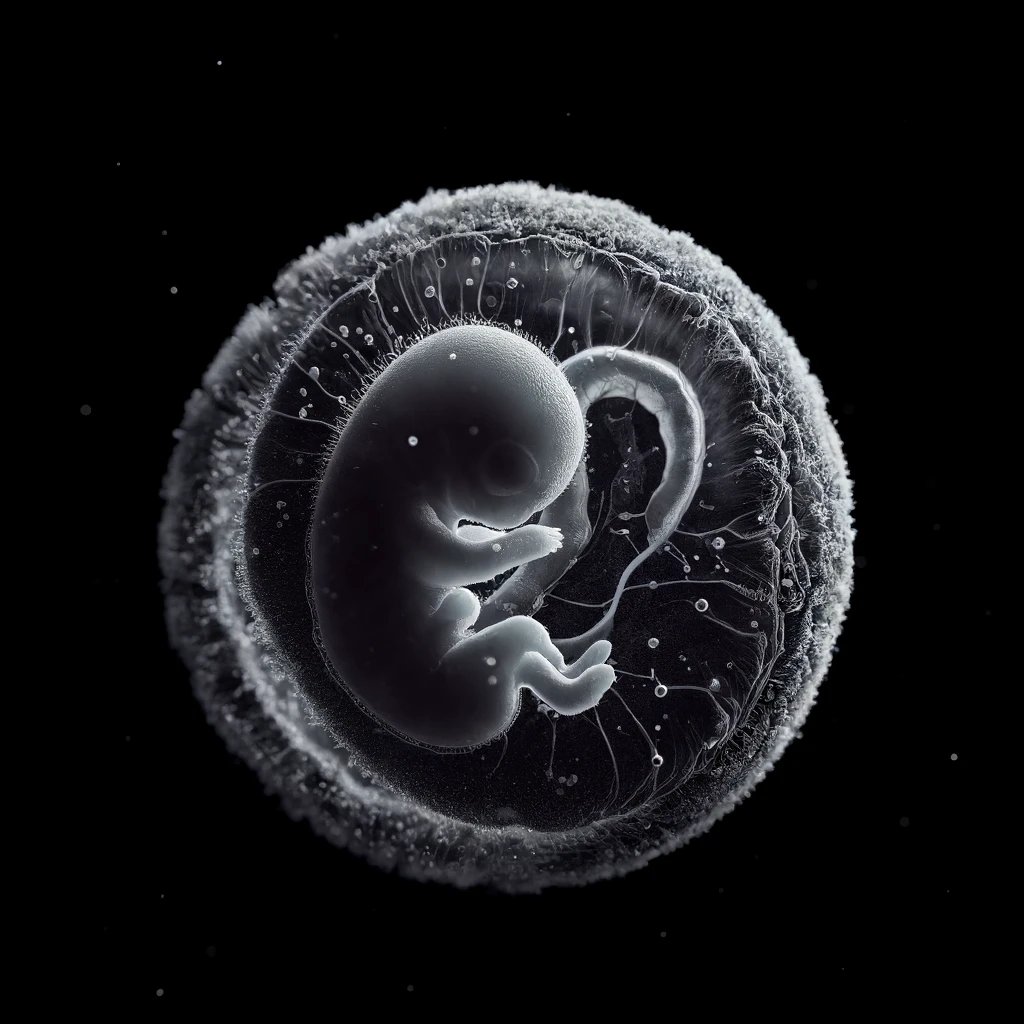
3 Weeks Pregnant: Fertilization Happens
All measurements are approximate: they are reference averages and every pregnancy is different. Your doctor checks your baby's growth at your visits and ultrasounds.
At 3 weeks pregnant fertilization happens: the sperm joins the egg and forms a zygote. It divides into many cells and travels toward the uterus as a blastocyst. Most women still notice no symptoms and a pregnancy test cannot detect it yet.
The key points of week 3
- Fertilization usually happens this week, shortly after ovulation.
- The fertilized egg (zygote) divides and forms a blastocyst that travels toward the uterus.
- It is still too early for a pregnancy test.
- Keep taking folic acid and avoid alcohol, tobacco and medicines you have not checked.
What happens in your body in week 3
Fertilization usually happens in week 3. A sperm joins the egg in the fallopian tube and a single cell called a zygote is formed. At that moment the genetic information of the mother and the father combine.
From one cell to a blastocyst
The zygote starts dividing again and again as it moves down the tube toward the uterus. After a few days it becomes a blastocyst, a small group of cells. One part will form the baby and another part will form the placenta.
The baby's sex
Genetic sex is settled at fertilization: it depends on whether the sperm carries an X or a Y chromosome. Even so, it will be many weeks before it can be seen on an ultrasound.
On the way to implantation
At the end of this week or the start of the next, the blastocyst reaches the uterus and begins to implant in its wall.
Your body and symptoms in week 3
Most women feel nothing in particular in week 3. Some notice mild changes, which can also be part of a normal cycle.
To find out whether you are pregnant, wait until your period is late and take a home test.
When to call your doctor or go to the emergency room
Seek medical care immediately if you have:
- Severe pain on one side of your lower abdomen, especially with bleeding or dizziness.
- Heavy bleeding, like a heavy period or more.
- Fainting or severe dizziness.
- Fever with pelvic pain.
In the US call 911. In other countries, go to the nearest emergency room.
Check-ups and tests at this stage
Every pregnancy is different: your doctor decides which tests you need and when.
| Check-up | When it is usually done | What for |
|---|---|---|
| Home pregnancy test | Around the time your period is late | Detect the pregnancy hormone (hCG) in your urine. |
| Folic acid | From before conceiving | Helps prevent neural tube defects. |
| Medication review | As soon as you start trying | Confirm with your doctor that they are safe. |
Tips for week 3
- Be patient with the test: taking it too early can give a false negative. Wait until your period is late.
- Habits: avoid alcohol, tobacco and drugs as if you were already pregnant.
- Food: avoid fish high in mercury, undercooked meat and unpasteurised dairy.
- Medicines: before taking any medicine or supplement, ask your doctor or pharmacist.
- For your partner: the wait can be nerve-racking. Keeping each other company and talking about how you feel helps you both.
Questions for your next visit
- When is the best time to take the pregnancy test?
- Which foods should I avoid while trying to conceive?
- Can I carry on exercising as usual?
- What do I do if I have light spotting?
Week 3 checklist
- Keep taking folic acid
- Avoid alcohol, tobacco and unchecked medicines
- Note the date your next period is due
- Keep a pregnancy test at home to use once you are late
Sources
Calculate your due date
Find out how many weeks and months pregnant you are and when your baby is due. It is an estimate: your doctor confirms it, usually with your first ultrasound.
The calculation runs on your device: the date is not sent or stored. It adds 280 days (40 weeks) to the first day of your last period, adjusting for the difference if your cycle is not 28 days; 266 days to the conception date; and 261 or 263 days to a day-5 or day-3 IVF embryo transfer. According to ACOG, a first-trimester ultrasound is the most accurate way to date a pregnancy: if your doctor gives you a different date, go by theirs. Source: ACOG. Methods for Estimating the Due Date.
Frequently asked questions about week 3
How many months is 3 weeks pregnant?
Three weeks is part of the first month and the first trimester. As it is counted from your last period, at week 3 the pregnancy is only just beginning: this is when fertilization usually happens.
Can I have pregnancy symptoms in week 3?
Most women notice nothing. Some have light spotting or mild cramps around implantation. These signs can also appear in a normal cycle, so they do not confirm a pregnancy.
Does a pregnancy test detect week 3?
Usually not. The test detects the hormone hCG, which is produced after implantation. The most reliable time is from the day your period is late, toward week 4.
What is implantation bleeding?
It is light spotting that some women notice when the embryo implants in the uterus. It is usually light and brief. Heavy bleeding or bleeding with severe pain is not implantation bleeding and needs medical attention.
When is the baby's sex decided?
Genetic sex is decided at fertilization, by the X or Y chromosome the sperm carries. But it cannot be seen until several weeks later, with an ultrasound or with medical tests.